
Best No-Pull Dog Harness for Reactive Dogs
5 real picks, tested against real specs and prices

Your dog spots another dog across the street and every ounce of calm walking you'd built up for the last ten minutes disappears in half a second. You're yanked forward, the leash goes tight, and you're doing that awkward half-jog to keep from getting pulled off your feet. Sound familiar? A regular collar harness wasn't built for that moment. It was built for a dog that pulls steadily toward a squirrel, not one that explodes sideways at another dog, a jogger, or a delivery truck.
Reactive dogs need something different from "no-pull" marketing copy on a generic Amazon harness. They need a harness that redirects a lunge without choking the throat, doesn't slip or twist mid-reaction, and gives you an actual mechanical advantage in the second it matters. That's a narrower category than "dog harness" search results suggest, and most roundups don't test for it.
We looked specifically for harnesses designed around chest-clip or dual-clip control, not just back-clip comfort harnesses relabeled as "no-pull" because they're padded. Every pick here has either a front leash ring, a martingale-style tightening loop across the chest, or both. We checked real current prices and pulled photos straight from each brand's own product page, not stock catalog images. We also weighted sizing systems and material durability, because a reactive dog under sudden tension will find any weak stitching or loose buckle within the first week.
1. 2 Hounds Design Freedom No-Pull Harness ($32.98)
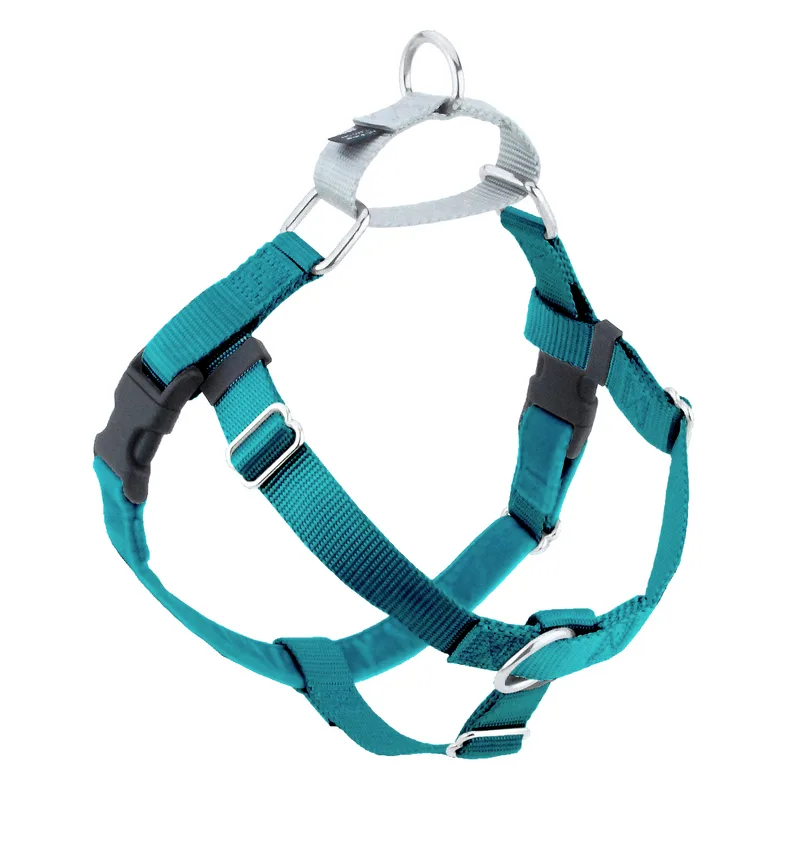
Shop 2 Hounds Design Freedom No-Pull Harness →
This one was built by trainers specifically for reactive and dog-aggressive dogs, and it shows. The dual-clip setup lets you run the included double-ended leash to both the front chest ring and the back ring at once, so a lunge tightens a soft martingale loop around the ribcage instead of yanking the throat or shoulders. Stainless steel hardware, Swiss velvet lining where the straps cross the chest.
The caveat: sizing runs less intuitive than a standard harness. You need to actually measure your dog's neck and ribcage with a fabric tape and cross-reference their chart, not just guess your dog's usual size. Get it wrong and the martingale loop either won't tighten enough to matter or tightens too far. Exchanges through their site take a few days to process.
Who it's for: dogs who lunge at triggers rather than steadily lean into the leash, and owners willing to spend ten minutes with a tape measure to get the fit right the first time.
- Dual leash attachment: front chest ring plus back ring
- Martingale-style tightening loop, not a fixed strap
- Sizes XS through XXL, adjustable at neck and girth
- Stainless steel D-rings and buckles
- Comes with a matching double-ended training leash
2. Blue-9 Balance Harness ($39.95)

Professional trainers reach for this one a lot, and the reason is the six-point adjustment. Every strap length, not just girth, tunes independently, so the harness sits square on the dog's body instead of twisting toward whichever side gets more tension. It also buckles at the neck instead of requiring you to drop it over the head, which matters more than it sounds like for a dog already keyed up about being touched near the face.
The honest tradeoff: there's no padding anywhere on this harness. It's all webbing, and on a dog with a short or thin coat, the straps can leave visible pressure lines after a long walk. First-time setup also takes longer than a two-buckle harness, since you're adjusting six points instead of two, and most owners need to redo the fit after the first walk once they see where it's riding.
Who it's for: owners who want the most precise, professional-grade fit and don't mind a slightly longer setup process. Skip it if you want something you can grab and clip in five seconds.
- Six independent adjustment points
- Four leash attachment rings (front, back, and two side)
- Buckle-neck entry, no over-the-head step
- Y-front chest design that clears the shoulder joint
- Sizes XS through XL
3. Ruffwear Front Range Harness ($59.99)
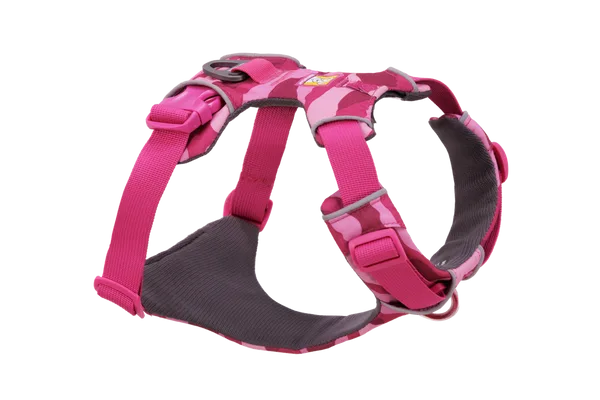
Shop Ruffwear Front Range Harness →
This is the harness for a reactive dog who's also a genuinely active one, hiking, trail running, long daily walks in all weather. Foam padding across the chest and belly spreads pressure out instead of concentrating it in a thin strap, which is noticeably kinder on a dog that pulls hard even for a second or two before you correct. Four points of adjustment, plastic hardware that's held up in over 4,200 customer reviews on the brand's own site.
The caveat: the front clip here is a single ring, not the dual-clip martingale setup on the 2 Hounds Design pick. It's a genuinely useful front attachment point for steering, but it won't tighten and self-correct the way a true no-pull design does on a hard lunge. It's also the most expensive harness on this list at $59.99.
Who it's for: dogs whose reactivity shows up as occasional lunging on otherwise long, active walks, where all-day comfort matters as much as the correction moment.
- Front and back leash attachment points
- Foam-padded chest and belly panels
- Four-point adjustable fit
- Reflective trim for low-light walks
- Sizes XXS through XL, plus a built-in ID pocket
4. Julius-K9 IDC Powerharness ($39.99)

Shop Julius-K9 IDC Powerharness →
Built originally for working and police dogs, this one prioritizes security over anything else. The chest strap is wide and non-restrictive, there's a sturdy handle on top for quick physical control, and the whole thing is escape-resistant enough that it's a common pick for dogs who've slipped out of a standard harness mid-reaction. That escape-resistance matters more for a reactive dog than most buyers realize.
The real caveat here: out of the box, this is a back-clip harness. Front-clip, no-pull control requires buying the separate IDC Front Control Y-Belt attachment, which isn't included and runs an extra charge. Skip it if you want no-pull functionality on day one without an add-on order.
Who it's for: large, strong, or escape-prone reactive dogs where physical security and a grab handle matter more than pull-redirection alone, especially if you're willing to add the Y-belt.
- Reinforced back D-ring plus top carry handle
- Wide, padded chest strap that doesn't restrict shoulder movement
- Reflective piping around the full harness
- Sizes from Mini-Mini through 5XL, fits bully breeds and giant breeds well
- Nylon construction rated for working-dog use
5. PetSafe Easy Walk Harness ($22.99)

Shop PetSafe Easy Walk Harness →
If you want the front-clip martingale mechanism without spending $40-plus to find out if it works for your dog, this is the entry point. It was originally developed with a veterinary behaviorist, and the chest loop tightens the same way the pricier picks do: gentle pressure that turns the dog back toward you instead of choking forward momentum. It's also the easiest one on this list to find in a physical pet store the same day you need it.
The caveat that shows up most in owner reviews: on dogs that pull hard and consistently, not just in short reactive bursts, the strap under the front legs can rub and chafe over time. There's also no back-clip option if you ever want to switch attachment styles for calmer walks.
Who it's for: owners testing whether a front-clip design works for their dog before committing to a more expensive, more adjustable harness, or anyone who needs a reliable no-pull option on a tight budget.
- Single front-clip martingale loop across the chest
- No-pull redirection without pressure on the throat
- Quick-adjust, quick-connect buckles
- Sizes petite through large
- Available in multiple colors
Comparison
A quick side-by-side before the full breakdown above.
- 2 Hounds Design Freedom No-Pull Harness: $32.98, dual front/back clip with martingale loop, best overall pick for true reactive-dog control.
- Blue-9 Balance Harness: $39.95, six-point adjustable, best fit precision, buckle-neck entry, no padding.
- Ruffwear Front Range Harness: $59.99, foam-padded front/back clip, best for active dogs on long walks.
- Julius-K9 IDC Powerharness: $39.99, reinforced and escape-resistant, best for large or escape-prone dogs, front-clip sold separately.
- PetSafe Easy Walk Harness: $22.99, single front-clip martingale, best budget entry point.
FAQ
Will a no-pull harness stop my dog from lunging entirely?
No single piece of gear replaces training, and none of these harnesses claim to. What they do is reduce the physical force of a lunge and redirect it toward you instead of letting your dog's full body weight go forward unchecked. Pair any of these with basic redirection training for real, lasting change.
Is a front-clip harness safe for a dog that pulls hard?
Yes, as long as it fits correctly. A front-clip or dual-clip design actually takes pressure off the throat compared to a collar, which is safer for a dog that pulls or lunges hard. The risk isn't the clip position, it's a loose or poorly sized harness that lets the dog twist or slip partway out mid-reaction.
Do I need a dual-clip harness, or is a single front-clip enough?
If your dog mostly leans into the leash steadily, a single front-clip harness like the PetSafe Easy Walk is usually enough. If your dog lunges suddenly, spins, or redirects their whole body toward a trigger, a dual-clip martingale design like the 2 Hounds Design Freedom harness gives you more actual control in that moment, since it tightens on its own instead of relying only on your grip.
How do I know if my dog's harness is sized correctly?
Measure your dog's neck circumference and the widest part of their ribcage (usually just behind the front legs) with a soft fabric tape, not a rigid one. Cross-reference both numbers against the brand's specific size chart rather than assuming your dog's usual collar size translates directly, since sizing systems vary a lot between brands. A correctly fitted harness should allow two fingers to slide flat under any strap, no more and no less.
“Five real no-pull dog harnesses tested against lunging, not just steady pulling. Prices, sizing notes, and honest caveats for reactive-dog owners.”
How to Choose
Start with how your dog actually reacts, not how hard they pull on an average day. A dog that leans steadily into the leash toward every smell needs a different fix than one that lunges hard and fast at a specific trigger. Steady pullers do fine with a single front-clip harness like the PetSafe pick. Dogs that lunge, spin, or redirect their whole body need the dual-clip martingale setups, since those actually tighten and self-correct in that half-second instead of just offering a different angle to pull from.
Fit matters more here than with a regular walking harness. A harness that's even slightly loose will let a lunging dog twist partway out of it, and one that's too tight will chafe or restrict the shoulder. Measure your dog's neck and ribcage before ordering rather than guessing off their usual collar size, and expect to make micro-adjustments after the first one or two walks.
Material and hardware matter too. Metal D-rings and buckles hold up better under repeated sudden tension than plastic clips, which is worth the extra few dollars if your dog's reactions are frequent rather than occasional. And don't ignore the handle. A top handle, like the one on the Julius-K9 pick, gives you a fast physical grab point in a moment when clipping and unclipping a leash isn't fast enough.
Finally, think about where you're walking. A padded harness earns its price on long trail walks and daily multi-mile routines. A lighter, unpadded harness like the Balance Harness is easier to size precisely and dries faster after a wet walk, which matters more in an apartment with limited gear storage. If your household is dealing with general dog-hair cleanup on top of walk logistics, a cordless vacuum built for pet hair solves a different but related problem worth knowing about. For general pet gear beyond harnesses, Naarayan's pet marketplace is worth a browse too.